

Understanding the right forms for registration is essential to maintain financial transparency and legality. While BIR Forms 1901 and 1902 cater to individual taxpayers, BIR Form 1903 serves as the indispensable instrument for corporations, partnerships, government agencies and instrumentalities (GAIs), local government units (LGUs), cooperatives, and associations.
In this article, we present a comprehensive guide on how to effectively utilize BIR Form 1903, ensuring that corporate entities can navigate the registration process seamlessly. It’s worth noting that the information provided here is intended for general knowledge purposes and should not be considered a substitute for seeking professional tax advice tailored to your specific circumstances.
Why Use BIR Form 1903?
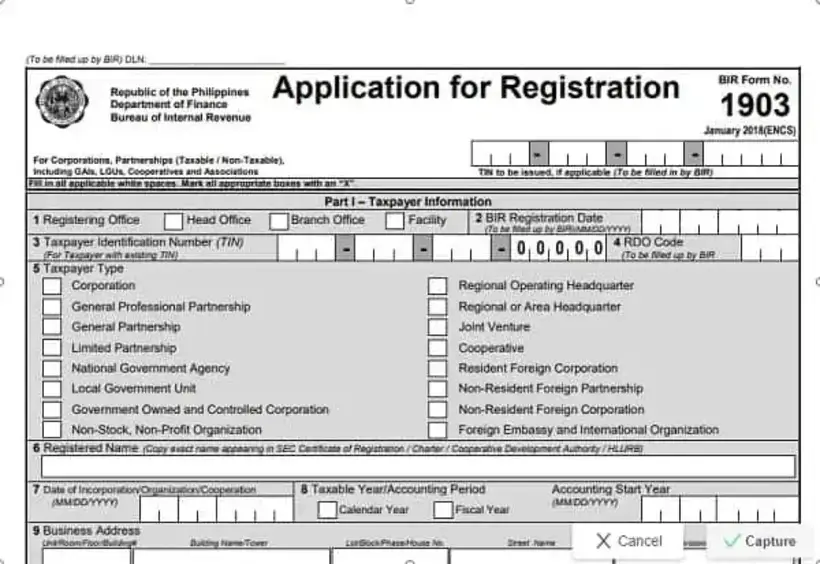
BIR Form 1903 serves as a vital tool for corporate taxpayers looking to formalize their presence with the Bureau of Internal Revenue (BIR) in the Philippines. Its primary purpose is to facilitate the registration of organizations and enable them to secure a Taxpayer Identification Number (TIN).
For corporations, it is a prerequisite that should be fulfilled before commencing their business operations, ensuring that they are in compliance with the tax regulations from the outset. Additionally, partnerships and non-profit entities are also required to file BIR Form 1903 either before or concurrently with their initial tax return submissions, making it an essential step in their regulatory obligations. This form plays a fundamental role in establishing a structured and compliant tax framework for these entities.
Who Needs to Fill Out BIR Form 1903?
BIR Form 1903 is a critical requirement for a wide range of entities in the Philippines, including:
- Corporations and partnerships, regardless of ownership (Filipino or foreign-owned), residence, or status (resident or non-resident).
- Non-stock, non-profit organizations dedicated to various causes and missions.
- Cooperatives, which play a vital role in promoting economic and social well-being.
- Associations of diverse kinds, such as homeowners associations, labor unions, and similar groups.
- National government agencies, contributing to the administration of the country.
- Government-Owned and Controlled Corporations (GOCCs), which serve various public purposes.
- Local Government Units (LGUs) that are at the forefront of governing and providing services within their respective regions.
These entities are all required to complete BIR Form 1903 as part of the essential process of registration and tax compliance in the Philippines.
What Does BIR Form 1903 Cost?
Corporations and partnerships in the Philippines are subject to specific financial obligations associated with their annual registration. This includes an Annual Registration Fee (ARF) of Php 500, in addition to a Php 15 Documentary Stamp Tax (DST) and a Php 15 Certification Fee.
It’s important to note that this payment is recurrent, with a due date set on or before January 31 of each year. While the registration itself is a one-time procedure, the ARF represents an annual financial commitment that these entities must fulfill to maintain their legal and tax compliance status.
Where to Officially Register Your Enterprise
The Revenue District Office (RDO) in the Philippines is responsible for overseeing the tax matters of various business locations, which include:
- Head Office: The primary and central administrative hub of a corporation or organization falls under the jurisdiction of a specific RDO. It is here that significant financial and tax-related decisions are typically made.
- Branch Office: Branch offices, extensions of the main entity, are subject to the oversight of the RDO governing the geographical area where they are located. Each branch must comply with local tax regulations.
- Regional Office Location: Regional offices, often overseeing a broader geographical area, also come under the jurisdiction of an RDO. This ensures that tax compliance is consistent across different regional operations.
RDOs play a pivotal role in streamlining tax collection and regulation by ensuring that each of these office types complies with tax laws and reporting requirements.
Essential Criteria for Submitting BIR Form 1903 by Corporations and Partnerships
When filing BIR Form 1903 for corporations and partnerships in the Philippines, it’s essential to provide a well-documented set of requirements. Here’s a breakdown of the key prerequisites to ensure a smooth registration process:
- BIR Form 1903: Two completed copies of BIR Form 1903 serve as the foundation of your registration application. Make sure the forms are accurately filled out with all the required details.
- For Domestic Corporations: For domestic corporations, include a photocopy of the Securities and Exchange Commission (SEC) Certificate of Incorporation and the Articles of Incorporation. These documents establish the legal framework and identity of the corporation.
- For Foreign Corporations: If you’re a foreign corporation seeking registration, provide a photocopy of the License to Do Business in the Philippines along with the Articles of Incorporation. These documents demonstrate your authorization to operate within the country.
- For Partnerships: In the case of partnerships, include a photocopy of the Certificate of Recording and the Articles of Partnerships. These documents validate the existence and terms of the partnership.
- Mayor’s Permit: Attach a photocopy of your Mayor’s Permit or a duly-received application form if the permit application is still in progress. The Mayor’s Permit indicates that you have local government clearance to operate within a specific area.
- Annual Registration Fee (ARF) Payment: Provide proof of payment for the Annual Registration Fee (ARF), which is a recurring obligation. If the ARF is unpaid at the time of registration, include two copies of the accomplished BIR Form 0605 (Payment Form).
- BIR Form 1906: Complete BIR Form 1906, which is the “Application for Authority to Print Receipts and Invoices.” This is a vital step, as it enables your business to issue official receipts and invoices.
- Sample Receipts or Invoices: Furnish a final and clear sample of principal receipts or invoices that your business will be using. These samples will be reviewed and approved as part of the registration process.
These requirements serve as the foundation for a successful registration process with the Bureau of Internal Revenue (BIR) and are essential to ensuring that your business operates in compliance with Philippine tax regulations.
Necessary Documents for Submitting BIR Form 1903 by Cooperatives
When it comes to registering cooperatives in the Philippines, it’s crucial to adhere to specific requirements to ensure a smooth and compliant process. Here’s a comprehensive breakdown of the essential documents and information you’ll need to submit alongside BIR Form 1903:
- BIR Form 1903: The foundation of your registration process involves filling out two copies of BIR Form 1903 meticulously. This form serves as the official declaration of your cooperative’s intention to comply with taxation regulations.
- Certificate of Registration from CDA: A photocopy of the Certificate of Registration issued by the Cooperative Development Authority (CDA) is paramount. This certificate authenticates your cooperative’s existence and is a fundamental document for establishing your cooperative’s legal status.
- Articles of Cooperation: Alongside the above documents, include a copy of the Articles of Cooperation, which outlines the key details regarding your cooperative’s structure, objectives, and internal policies. This document is vital in defining your cooperative’s purpose and functioning.
- BIR Form 1906: Don’t forget to complete BIR Form 1906, the “Application for Authority to Print Receipts and Invoices.” This is essential for your cooperative to obtain the necessary authorization to issue official receipts and invoices.
- Sample of Principal Receipts or Invoices: Provide a clear and final sample of principal receipts or invoices that your cooperative intends to use. These samples will undergo review and approval as part of the registration process and are critical for your cooperative’s tax compliance.
By diligently assembling these documents and ensuring they are in order, your cooperative can navigate the BIR Form 1903 filing process efficiently and effectively. This not only establishes your cooperative’s presence within the tax framework but also contributes to your ability to engage in financial transactions and provide receipts or invoices as required by law.
Essential Documentation for Submitting BIR Form 1903 by Associations
Registering associations in the Philippines requires a careful assembly of the necessary documentation to facilitate a successful registration process. Here’s a comprehensive guide outlining the key documents and information you’ll need to submit alongside BIR Form 1903, categorized by the type of association:
1. BIR Form 1903: The foundational document in the registration process is BIR Form 1903. Ensure that two copies of this form are meticulously filled out, providing accurate information that aligns with your association’s particulars.
2. For Homeowners Associations:
- Certificate of Registration from HLURB: Include a photocopy of the Certificate of Registration issued by the Housing and Land Use Regulatory Board (HLURB). This document is essential for verifying the legitimacy of homeowners’ associations.
- Articles of Association: Present a copy of the Articles of Association, outlining the purpose, rules, and regulations governing the homeowners’ association.
3. For Labor Unions:
- Certificate of Registration from DOLE: Attach a photocopy of the Certificate of Registration granted by the Department of Labor and Employment (DOLE). This certificate validates the existence of the labor union.
- Constitution and By-laws: Provide a copy of the labor union’s Constitution and By-laws, outlining its internal governance and operational procedures.
4. BIR Form 1906: Completing BIR Form 1906, the “Application for Authority to Print Receipts and Invoices,” is a necessary step to secure the authorization to issue official receipts and invoices.
5. Sample of Principal Receipts or Invoices: Include a final and clear sample of principal receipts or invoices that your association intends to use. These samples undergo review and approval as part of the registration process and are critical for your association’s tax compliance.
By adhering to these requirements, your homeowners association or labor union can seamlessly navigate the BIR Form 1903 filing process. This not only establishes your association’s presence within the tax framework but also ensures compliance with the law and facilitates financial transactions and official documentation.
Filing BIR Form 1903 for Corporate Taxpayers: A Step-by-Step Guide
For corporate entities in the Philippines, the process of filing BIR Form 1903 is a vital step in ensuring tax compliance and legal operation. This guide breaks down the essential steps for corporate taxpayers to complete this registration process.
1. Submission of Documents at the New Business Registrant Counter
Your journey to compliance begins by visiting the New Business Registrant Counter at your assigned Revenue District Office (RDO). Here, you’ll need to submit a collection of required documents, as detailed in our previous section. The registration officer at the RDO will enter your information into the BIR database, which includes the critical step of generating a Taxpayer Identification Number (TIN). The assigned TIN will be recorded on BIR Form 0605.
2. Payment of Registration Fee and Documentary Stamp Tax (DST)
Corporate entities, including corporations and partnerships, are obliged to pay the registration fee. This fee can be paid at the RDO’s authorized agent bank using BIR Form 0605. Once you’ve made the payment, you’ll receive two crucial documents: the proof of payment in the form of an official receipt and the machine-validated BIR Form 0605, which signifies that the payment has been processed.
3. Return for Documentary Stamp Tax (DST) and Certification Fee
Upon obtaining the proof of payment and machine-validated BIR Form 0605, return to the RDO. At this stage, you’ll be required to pay the Documentary Stamp Tax (DST) and certification fee. Ensuring that these fees are settled marks a significant step towards completing the registration process.
4. Attend the New Business Registrants’ Briefing
Participating in the briefing for new business registrants is an important component of the process. This session provides valuable insights and information, helping you navigate tax regulations effectively. It’s an opportunity to understand your obligations and rights as a taxpayer in the Philippines.
5. Await the Release of BIR Registration Documents
After completing the required payments and the registration process, your corporate entity will receive several essential documents. These include BIR Form 2303 (Certificate of Registration), an “Ask for a Receipt” Notice (ARN), Authority to Print (ATP) documents, and BIR-printed receipt/invoice if applicable. You’ll also receive an eReceipt as proof of payment, which is a valuable record to retain.
Please note that if you already possess an existing TIN, you can save time by paying the Annual Registration Fee (ARF) in advance before registering with the BIR using BIR Form 0605. This can streamline the process and enhance your corporate tax compliance.