
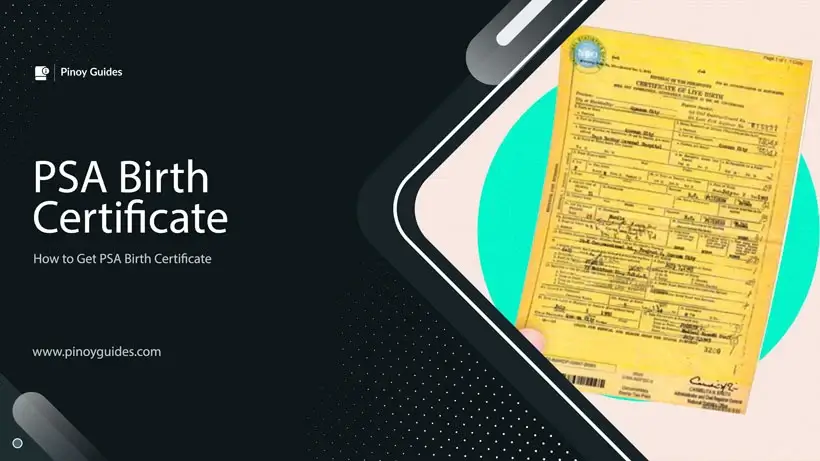
The PSA birth certificate is a document in high demand across diverse scenarios, serving as a prerequisite for numerous circumstances. It stands as a crucial requirement during employment processes, with human resources often requesting it upon hiring.
Additionally, individuals lacking a date of birth on their valid IDs find it indispensable when applying for civil service exams. The significance extends further, encompassing the acquisition of essential government-issued documents such as the Philippine passport and driver’s license.
While applying for a birth certificate is a routine task, this guide provides comprehensive insights into various methods, including the traditional walk-in approach at designated offices and the convenience of online ordering. Whether you are in the Philippines or anywhere around the globe, this resource outlines the different avenues to swiftly obtain your PSA birth certificate.
What is a Birth Certificate?
A birth certificate, as defined by the Philippine Statistics Authority (PSA), is a crucial record that officially documents a child’s birth. It serves as a comprehensive proof of identity, establishing details such as place of origin, nationality, and other key information.
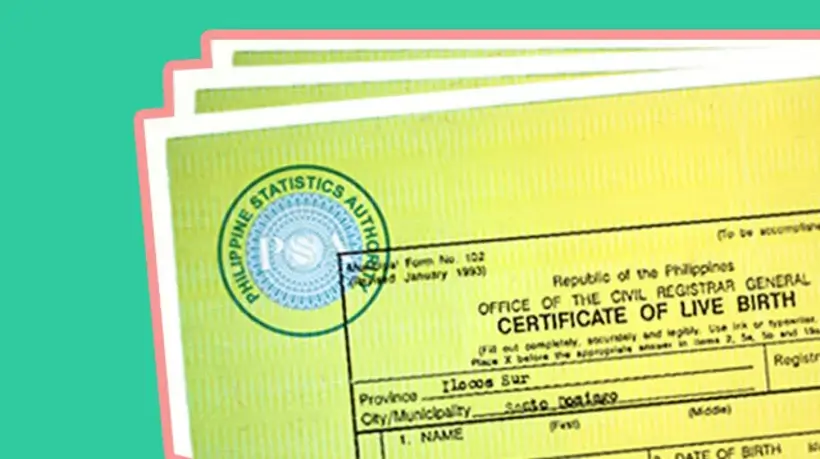
This vital document includes:
- the time, date, and place of birth,
- the complete name of the individual,
- gender,
- nationality,
- and the names of the parents.
Filed by the attending doctor shortly after a baby’s birth, the birth certificate is then issued and stored by the local civil registrar (LCR). These records are subsequently archived at the Philippine Statistics Authority. The term “birth certificate” can refer to either the original document or a certified true copy.
While the birth certificate itself has no expiration date, changes in the Security Paper may occur over time to prevent the creation of fake certificates.
Notably, various government agencies and institutions, including the DFA, BIR, DepEd, PVAO, SSS, schools, and embassies, may require recent or new authenticated birth certificates for different purposes.
Overall, a birth certificate is indispensable for job applications, obtaining government-issued IDs, proving nationality, and verifying legitimacy.
Who Has the Authority to Request and Receive a PSA Birth Certificate?
Authorized individuals eligible to request and receive a PSA birth certificate encompass a specific group:
- The owner of the birth certificate: The primary individual for whom the birth certificate pertains.
- Spouse of the owner: The legal partner of the birth certificate owner.
- Parent of the owner: Biological or adoptive parents of the birth certificate owner.
- Child of legal age of the owner: Offspring who have reached the age of legal independence.
- Guardian appointed by the court or person exercising substitute parental authority (if the owner is a minor): Designated individuals with legal responsibility for minors.
When the birth certificate owner is a minor, only parents or the court-appointed guardian have the authority to receive or authorize its delivery. To facilitate the process, the person receiving the birth certificate must present a valid ID. If the recipient is the minor’s guardian, both a valid ID and proof or declaration of guardianship are necessary for authentication.
Requirements for Getting a PSA Birth Certificate
1. Valid ID
Accepted valid IDs for requesting a PSA Birth Certificate include:
- Philippine Passport (DFA): A primary identification document issued by the Department of Foreign Affairs.
- Driver’s License (LTO): A license issued by the Land Transportation Office, serving as both an identification and driving permit.
- PRC ID: Professional Regulation Commission Identification Card for licensed professionals.
- IBP ID: Integrated Bar of the Philippines Identification Card for lawyers.
- GSIS Unified Multi-Purpose ID/eCard: Government Service Insurance System ID for government employees.
- SSS Unified Multi-Purpose ID: Social Security System ID for SSS members.
- Pag-IBIG Transaction/Loyalty Card: Home Development Mutual Fund ID for Pag-IBIG members.
- Voter’s ID (COMELEC): Commission on Elections Identification Card for registered voters.
- Postal ID (PhilPost): Philippine Postal Corporation Identification Card.
- Senior Citizen’s ID Card (OSCA/LGUs): Identification card for senior citizens issued by the Office of Senior Citizens Affairs or local government units.
- OFW ID (DOLE): Overseas Filipino Worker Identification Card issued by the Department of Labor and Employment.
- OWWA ID: Overseas Workers Welfare Administration Identification Card for OFWs.
- Seaman’s/Seawoman’s Book (MARINA): Maritime Industry Authority ID for seafarers.
- Diplomat/Consular ID (Philippine Embassy): Identification card for diplomats and consular officers issued by Philippine embassies.
- NBI Clearance: National Bureau of Investigation clearance.
- PNP ID/Police Clearance: Philippine National Police Identification Card or police clearance.
- DSWD Certification/4Ps ID: Department of Social Welfare and Development Certification or 4Ps (Pantawid Pamilyang Pilipino Program) ID.
- Barangay ID/Certification with picture and signature: Barangay-issued identification or certification with a photo and signature.
- PWD ID (NCDA/Office of the Mayor/Office of the Barangay Captain/DSWD/other participating organizations with MOA with DOH): Persons with Disabilities Identification Card issued by various authorized entities.
- IDs issued by National Government Offices and GOCCs: IDs issued by National Government Offices and Government-Owned and Controlled Corporations.
- IDs issued by Offices of Local Chief Executives: Identification cards issued by local government offices.
- TIN Card (BIR): Tax Identification Number Card issued by the Bureau of Internal Revenue.
- School/Student ID (for students 18 years old and above, issued by reputable schools/colleges/universities recognized by DepEd or CHEd, signed by the principal/head of the academic institution): Identification card for students issued by recognized educational institutions.
- Company IDs (private entities registered with BSP, SEC, or IC): Identification cards issued by private entities registered with the Bangko Sentral ng Pilipinas, Securities and Exchange Commission, or Insurance Commission.
- For foreign nationals: Passport issued by foreign governments and either (a) ACR I-card, (b) Immigrant Certificate of Registration, or (c) Special Resident Retiree Visa (issued by BI through PRA).
Document owner claiming the PSA Birth Certificate must bring the original and photocopy (front and back) of the valid ID, present the original, and submit the photocopy.
Authorized representatives should bring the original and photocopy (front and back) of both the document owner’s and representative’s valid ID, present the original, and submit the photocopy.
2. Special Power of Authority (SPA) or Authorization Letter
Authorization Letter or Special Power of Attorney (SPA) becomes a necessity when the document owner is unable to personally claim the PSA Birth Certificate. To ensure a smooth and valid process, follow these guidelines for creating an Authorization Letter or SPA:
- Specify the Purpose: Clearly state the purpose of the document, such as securing a copy of the PSA Birth Certificate. General statements are not accepted to avoid ambiguity.
- Detail the Document: Indicate the specific type of document (PSA Birth Certificate), specify the number of copies required, and provide other pertinent details about the document to be requested.
- Authorization Letter:
- If opting for an authorization letter, it must be handwritten or computerized/printed on a clean sheet of paper.
- The letter should bear the fresh signature of the document owner for authentication.
- Letters sent via email or messaging apps are not accepted to ensure the integrity of the authorization.
- Special Power of Attorney (SPA):
- If using an SPA, it must be notarized to establish its legal validity.
- The purpose stated in the SPA should not have been served or reached its expiry, adhering to the provisions of Article 1919 of the Civil Code of the Philippines.
By adhering to these guidelines, individuals can properly delegate authority to claim the PSA Birth Certificate on their behalf, maintaining the necessary legal and procedural standards.
How Can I Get a PSA Birth Certificate Online Through PSA Serbilis?
PSASerbilis serves as an online platform enabling you to request a birth certificate for delivery within the Philippines or globally. Here’s the process for acquiring your birth certificate through this website:
1. Visit the PSASerbilis online platform
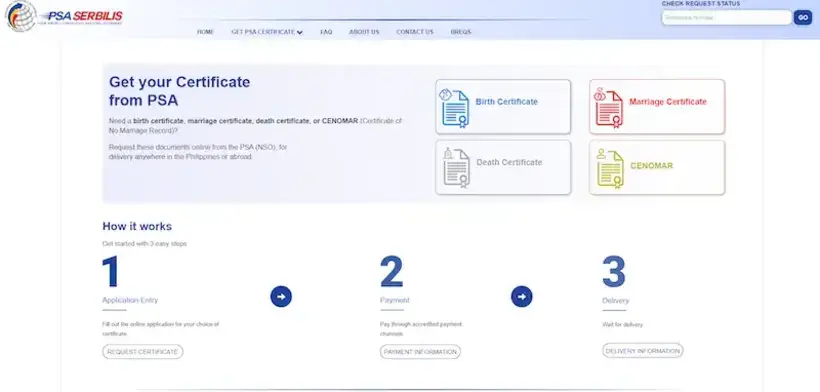
Navigate to the homepage and choose “Birth Certificate.”
Check the boxes to indicate your agreement with the terms and conditions as well as the data privacy notice. Proceed by clicking the “Next” button.
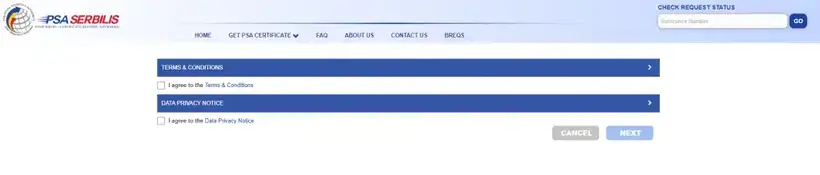
Following that, provide responses to inquiries regarding potential corrections in the birth certificate you are applying for and confirm if you have previously obtained a PSA Birth Certificate. Select “Next” to proceed.
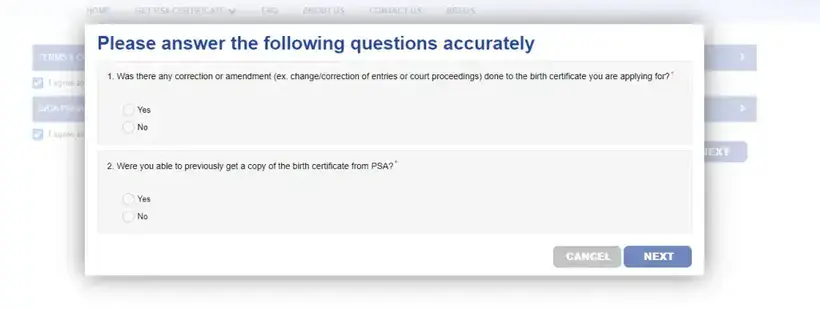
2. Proceed with your registration by completing the Request Details form
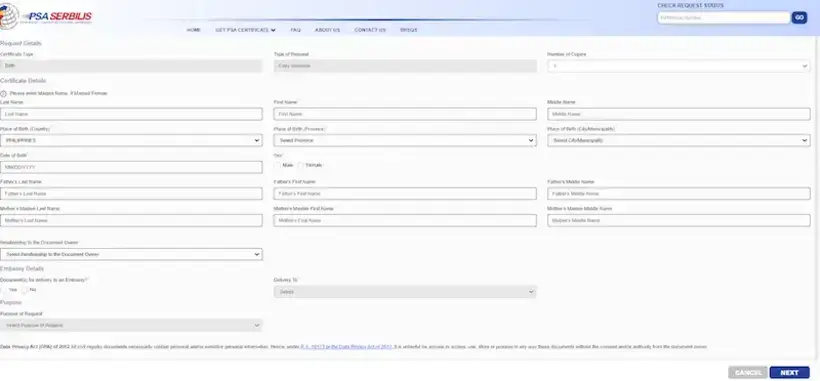
When completing the form for requesting a PSA Birth Certificate online, it’s crucial to input accurate and detailed information. Here’s a breakdown of the details to enter:
- Number of Copies (1 to 12): Specify the quantity of birth certificate copies needed, keeping in mind the minimum requirement of one and a maximum of 12.
- Birth Certificate Owner’s Name (Last Name, First Name, Middle Name): Provide the full name of the birth certificate owner, ensuring correct sequencing of last name, first name, and middle name.
- Place of Birth (Province, City/Municipality): Clearly indicate the birthplace by specifying the province and city or municipality.
- Date of Birth: Enter the accurate date of birth of the individual for whom the birth certificate is being requested.
- Sex: Specify the gender of the birth certificate owner.
- Father’s Complete Name (Last Name, First Name, Middle Initial): Input the full name of the father, including last name, first name, and middle initial.
- Mother’s Complete Maiden Name (Last Name, First Name, Middle Initial): Enter the complete maiden name of the mother, including last name, first name, and middle initial.
- Relationship to the Owner (e.g., Self, Mother, Father, etc.): Indicate the relationship of the requester to the birth certificate owner, whether it’s the individual themselves or someone else.
In addition to these essential details, there are additional choices to make:
- Choose Delivery to an Embassy (Yes/No): Indicate whether the birth certificate should be delivered to an embassy.
- Select Embassy for Delivery from the Provided Dropdown List: If embassy delivery is chosen, select the specific embassy from the provided dropdown list, which includes options like the US Embassy in Manila, UKVI, British Embassy Manila, and Consulate General of Spain Manila.
- Choose the Purpose of the Request Using the Dropdown Menu: Select the purpose of the birth certificate request from the available dropdown menu options.
Important notes for filling out the form:
- If you’re a married woman, use your maiden name.
- Use only letters, numbers, hyphens, single quotes, and ñ/Ñ in names.
- Place name suffixes like “Jr,” “Sr,” or “III” in the First Name field without a period.
- Use Roman numerals for male name suffixes (e.g., “III” instead of “THIRD”).
- For surnames starting with “De,” “De La,” “Del,” or “De Los,” enter these in the Last Name field. Use “De La” or “De Los” (with space) instead of “Dela” or “Delos.” Following these guidelines ensures a smooth and accurate processing of your PSA Birth Certificate request.
3. Input the requester’s information and specify delivery details
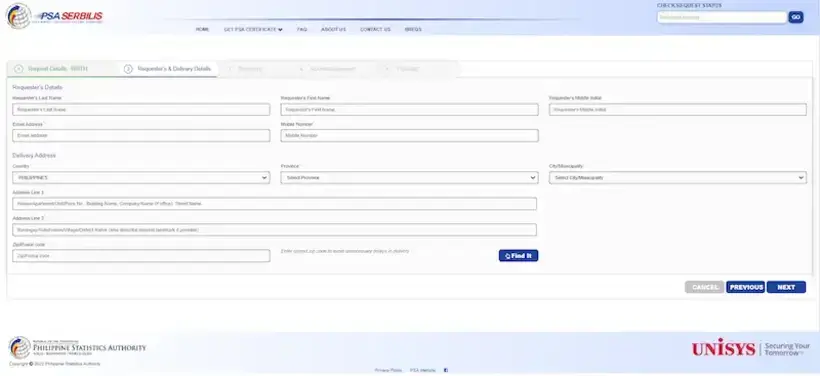
When entering details in the PSA Birth Certificate request form, you’ll need to provide both the requester’s information and delivery details. Here’s a breakdown:
a. Requester’s details:
- Requester’s Name (Last Name, First Name, Middle Initial): Input the full name of the requester, ensuring correct sequencing of last name, first name, and middle initial.
- Telephone/Mobile Number: Enter a valid telephone or mobile number to facilitate communication regarding the birth certificate request.
- Email Address: Provide a functional email address for electronic communication and updates regarding the application.
b. Delivery Address:
- Address (Country, Province, City/Municipality): Specify the complete delivery address, including the country, province, and city or municipality.
- ZIP/Postal Code: Include the ZIP or postal code corresponding to the delivery address for accurate processing.
Click “Next” when the form is filled out to proceed to the confirmation step.
Confirmation Step:
During the confirmation step:
- A box appears to confirm the accuracy of the provided information.
- The delivery schedule is from 8 AM to 5 PM on weekdays.
- If the information is accurate, click “Confirm.”
After confirmation, PSASerbilis presents a summary of the online application.
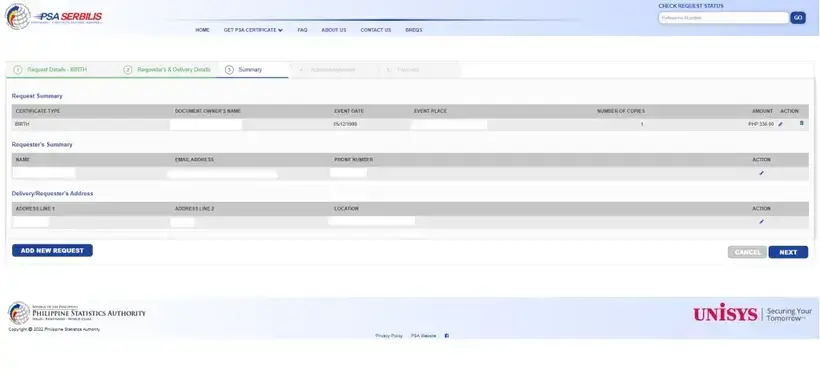
If you wish to request an additional PSA-issued document, simply click the “Add New Request” button. Otherwise, proceed by clicking “Next.”
4. View the Acknowledgment Page and make two printed copies
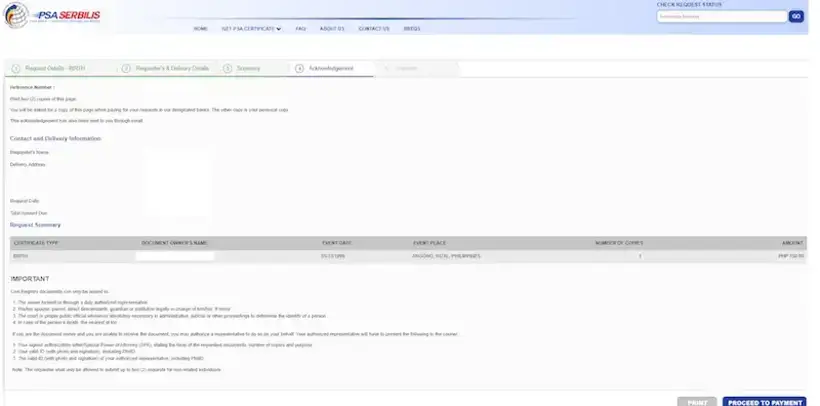
Upon completion of the online application, the system generates two pages:
- the Hard Copy for Payment, to be presented at a PSA-designated bank during payment,
- and the Personal Copy, which is retained by the requester.
- Simultaneously, a soft copy of the acknowledgment page is sent via email.
To obtain physical copies of the page, click the Print button. Following printing, click “Proceed to Payment” to seamlessly advance through the request process.
5. Complete the payment for the Birth Certificate Request fee either offline or online
Selecting a suitable payment method for your Birth Certificate Request fee is a straightforward process, thanks to a range of convenient options.
For offline transactions within the Philippines, you can visit:
- Bayad Centers, Bayad Partners (such as Robinsons Department Stores, Ministop, LBC, 2GO, etc.),
- or use the Bayad Online or Bayad App with PSA Serbilis as the biller.
- Paymaya App is also a viable offline payment option.
For those requesting birth certificates from foreign countries, BDO Remit Subsidiary Offices and Remittance Partners offering Kabayan Bills Bayad provide a seamless offline payment experience.
On the online front, you can opt for:
- Debit/Credit/Prepaid Cards (e.g., Visa, Mastercard, American Express),
- GCash (for local deliveries in the Philippines),
- or leverage accredited banking payment channels like BDO Unibank and Unionbank.
Keep in mind that the Birth Certificate cost is ₱330 for local delivery in the Philippines and USD 20.30 for international delivery. Choose your preferred payment method to complete the transaction efficiently and securely.
6. Wait for the Arrival of Your Delivery
The delivery timeframes for PSA Birth Certificates vary based on the location and the chosen delivery option.
- In Metro Manila, you can expect delivery within 3-5 working days after payment.
- For other cities and provinces within the Philippines, the timeframe extends to 4-9 working days after payment.
- If the delivery is to another country, the process takes approximately 6-8 weeks after payment.
For those seeking expedited delivery options, you can apply in person at the nearest PSA CRS outlet in the Philippines, ensuring delivery within 1 to 2 days after payment.
If you’re abroad, the e-Census Special Courier Service provides a swift alternative.
Delivery schedules operate from 8 A.M. to 5 P.M., Monday to Friday, excluding holidays, ensuring a convenient and efficient process for receiving your PSA Birth Certificate.
How Can I Get a PSA Birth Certificate at a PSA CRS Outlet?
The most budget-friendly option for obtaining your PSA Birth Certificate involves visiting the nearest PSA CRS (Civil Registration System) Outlet in your town or city.
However, certain considerations and preparations are crucial for a smooth process. Appointments are a necessity, and PSA offices operate on a first-come, first-serve basis. It’s important to note that minors cannot directly book appointments; legal guardians must secure slots online. Adequate preparation is key, so ensure you have all the required documents ready, as detailed in the previous section.
To secure an appointment, follow the outlined steps provided by the PSA, ensuring you have the basic requirements on hand. This approach offers a cost-effective way to obtain your PSA Birth Certificate, emphasizing the importance of careful planning and adherence to the established procedures.
Here’s a step-by-step guide to assist you:
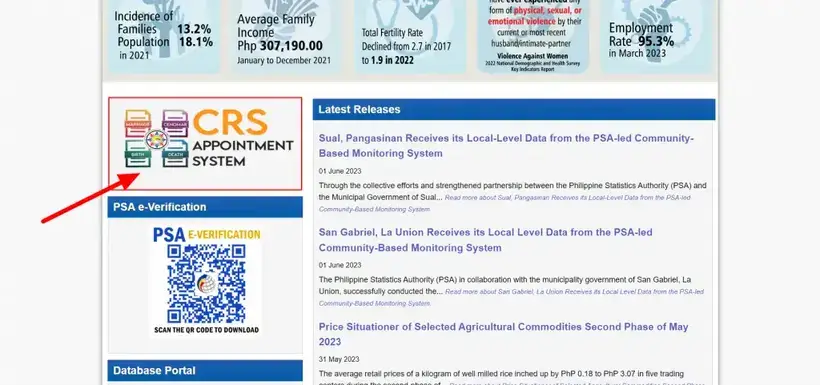
- Visit the PSA Website: Go to the official PSA website and select the CRS Appointment System.
- Agree to Terms: Scroll down, tick the “I Agree” box, and click Next to proceed.
- Choose Region and Outlet: Select your region and specify the preferred PSA CRS Outlet. For NCR with legal instruments, booking at East Avenue is advisable. Click Next.
- Fill out the Online Form: Complete the online form with your name, email, and mobile number, ensuring they match your valid ID. Agree to the collection of personal information for appointment booking and click Next.
- Receive and Verify OTP: Receive an OTP via email, paste it onto the page, and click Verify.
- Select Certificate Type and Relationship: Choose the certificate type and your relationship with the document owner. If requesting your PSA Birth Certificate, select “Self”; otherwise, choose the relationship and provide the owner’s name. Click Next.
- Choose Appointment Date and Time: Select your preferred date and time for the appointment. Click a date on the calendar, choose a time slot, and click Next.
- Review and Confirm Appointment: Review the appointment details, confirming that the information aligns with your valid ID. Click Confirm.
- Receive Appointment Slip: Check your email for the Appointment Slip (PDF), save it, and print the form with the QR code.
- Attend the Appointment: On the appointment day, go to the chosen PSA CRS Outlet, bringing the original and photocopy of the valid ID and any other necessary documents if you have an authorized representative. Arrive early and bring a pen.
With the convenience of online appointments, obtaining a PSA Birth Certificate can now take approximately an hour, and the cost is ₱155 as of this writing. This digitized process enhances efficiency, reducing the time and effort required to secure this essential document.
How Can I Get a PSA Birth Certificate through Walk-In at an SM Business Center?

Embracing a nationwide welcome, SM Business Centers are hubs for walk-in applications throughout the Philippines. Since the collaborative partnership established in 2010 between SM and the National Statistics Office (NSO), these centers, often situated within SM Department Stores, have played a pivotal role in processing and releasing civil registry documents.
From birth and death certificates to marriage certificates, SM Business Centers offer a comprehensive suite of services, extending beyond civil registry functions. With a commitment to accessibility, these centers provide various services such as foreign exchange, bills payment, BDO Remit, and the facilitation of SSS and Pag-IBIG contributions.
The advantage of choosing SM Business Center for birth certificates lies in its widespread accessibility, ensuring that individuals in almost every town and city across the country can easily access these vital services.
Here’s a comprehensive guide to assist you:
- Location Visit: Head to the nearest SM mall and locate the SM Business Center, commonly situated within SM Hypermarket or SM Department Store.
- Inquiry Assistance: Seek assistance from security guards or SM staff if needed. Utilize the SM store directory or inquire to confirm the presence of an SM Business Center.
- Queueing: Line up at the dedicated section for processing civil registry documents. Present one valid ID from the provided list to proceed with your application.
- Form Acquisition and Completion: Obtain the birth certificate application form and fill it out accurately. Additionally, complete a smaller form indicating the required number of copies and the owner’s personal information for SM’s records.
- Payment: Submit the completed form and proceed to the cashier to pay ₱180 for the processing fee. Upon payment, receive an Official Receipt and a claim stub indicating the expected document release date, typically within 4 to 6 days.
- Claim Process: Return to the SM Business Center on the specified date to claim your birth certificate. Present your valid ID, receipt, and claim stub for verification purposes. In case you’re unable to claim the document personally, an authorized representative must provide their valid ID, your valid ID, and an authorization letter with your signature.
Following these steps ensures a smooth and efficient process for obtaining your PSA Birth Certificate through a walk-in application at an SM Business Center, emphasizing the convenience of this widely accessible service.
Tips and Warnings for Getting a PSA Birth Certificate
1. The PSA does not hold records of birth certificates for individuals born prior to 1945
The acquisition of a PSA (Philippine Statistics Authority) Birth Certificate can encounter limitations for individuals born before 1945. The PSA, responsible for maintaining vital records, does not possess birth certificates for individuals born during or prior to this period. In such cases, the PSA issues a Negative Results Certification, indicating that no birth record has been found in their archives.
While the PSA may not hold records for those born before 1945, alternative avenues exist for individuals seeking documentation:
- Negative Results Certification: For those born before 1945, the PSA issues a Negative Results Certification, signaling the absence of a birth record in their archives.
- Accessible Records: Electronic and paper archives maintained by the PSA contain records for births, marriages, and deaths reported from 1945 to the present. However, for Manila specifically, birth records are available from 1951 onwards.
Options After Negative Results Certification: Individuals facing a Negative Results Certification have several options to explore:
- Option 1: Visit Local Civil Registrar: Visit the local civil registrar with jurisdiction over the person’s place of birth. Although the chances of finding very old records may be slim, it’s worth checking their archives. If records are found, follow the endorsement procedure for further processing.
- Option 2: Inquire About Late or Delayed Birth Registration: If neither the PSA nor the local civil registrar can retrieve a birth record, individuals may inquire about late or delayed birth registration.
- Option 3: National Archives of the Philippines: For a more extensive search, visit the National Archives of the Philippines located at PPL Building, U.N. Avenue, corner San Marcelino St, Manila. If a birth certificate is located, undergo the Reconstruction process, and the final copy is sent to the PSA for encoding.
Navigating these options allows individuals born before 1945 to explore alternative avenues for obtaining documentation, acknowledging the limitations posed by the PSA’s records.
2. You have the option to apply for “advance endorsement” if you wish to secure a copy of your recently born child’s birth certificate
Navigating the process of obtaining a birth certificate for a recently born child can be challenging due to the standard “posting period” implemented by the PSA (Philippine Statistics Authority). This period involves the verification and digital conversion of new birth records before they are officially processed and made available.
The duration of the posting period varies based on the birth location and existing records at the PSA.
- For births in Metro Manila, the standard processing time is 2 to 4 months,
- while provincial or locations outside Metro Manila may take at least 6 months.
To address the immediate need for a newborn’s birth certificate and bypass the standard posting period, individuals can opt for the “advance endorsement” option. This involves filing the request at the local civil registrar (LCR) where the child was born. Although this incurs a fee, it enables the LCR to endorse a copy of the birth certificate to the PSA ahead of the regular submission schedule.
The benefits of choosing “advance endorsement” include faster processing of the newborn’s birth certificate and the ability for the LCR to submit records to the PSA before the usual schedule. This option provides a practical solution for parents who require swift access to official documentation for their recently born child, ensuring a more expedited and convenient process.
3. Filipinos born outside the Philippines can also get a PSA birth certificate
Filipinos born abroad are eligible to obtain a PSA (Philippine Statistics Authority) birth certificate if a Report of Birth was duly filed by the parent or parents at the Philippine Consulate in the child’s country of birth within one year from the date of birth.
The registration process begins with the submission of the child’s birth record to the Consular Records Division of the Department of Foreign Affairs (DFA) in Manila after registration at the Philippine Consulate.
The timing for PSA submission is crucial, as civil registry documents, including birth records, are forwarded to the PSA every quarter. To request the PSA birth certificate, individuals should wait at least two months after the PSA receives the birth record from the DFA.
When initiating the request process, it is essential to provide specific information from DFA Manila’s Consular Records Division, including the reference number, dispatch number, dispatch date, and transmittal date. This crucial data should be sent to info@psaserbilis.com.ph.
Subsequently, the PSA will conduct a thorough search and retrieve the birth records based on the provided details, ensuring a streamlined and efficient process for obtaining the PSA birth certificate for Filipinos born abroad.
4. The DFA continues to accept the NSO Birth Certificate for passport applications
When applying for a Philippine passport, one of the crucial documentation requirements is the submission of an original PSA Authenticated Birth Certificate on Security Paper (SECPA). In this context, the Department of Foreign Affairs (DFA) clarifies on its FAQ page that NSO (National Statistics Office) birth certificates are still considered valid and are accepted for passport applications.
There are specific conditions for the usage of existing NSO copies—these copies remain acceptable as long as they are in good condition with no tampered entries. Importantly, there is no need to request a new PSA copy if the existing NSO copy meets these criteria.
It’s worth noting that the mandatory requirement for birth certificates applies primarily to new passport applications and specific purposes, with an exception for passport renewal applicants who are not obligated to provide a PSA birth certificate for the renewal process.
5. A distinction exists between a Birth Certificate and a Certificate of Live Birth (COLB)
The Certificate of Live Birth (CLB) serves as the initial unofficial document confirming a person’s medical existence at birth. This form is primarily designed for data entry and is completed by the parents. The hospital administrator then forwards the form to the local civil registrar within 30 days post-birth.
The data processing journey involves the local civil registrar sending the records to the Philippine Statistics Authority (PSA) for verification and encoding. Only after a few months can individuals request the Official Birth Certificate, which comes with distinctive features.
The Official Birth Certificate is printed on security paper (SECPA), includes a registration number for quick retrieval, and bears the official PSA seal, ensuring its authenticity.
6. In instances of dual birth certificates or double registration, the initial registration will be acknowledged as the official birth certificate
In the Philippines, the creation of dual birth certificates is strictly prohibited, yet unintentional cases may arise, particularly during the late registration of a birth or due to mistakes in the application process.
In these situations, the first registered birth certificate takes precedence and is recognized as the official document, regardless of any errors present. If errors exist in the initial certificate, the appropriate correction process should be followed.
The status of the second birth certificate is considered invalid, and it must undergo a formal cancellation process through a Petition for Cancellation of Entry. This petition is filed before the Regional Trial Court (RTC) with jurisdiction over the civil registrar of registration.
The cancellation process involves filing the petition, after which the court orders a hearing, notifies all involved parties, and publishes notices in a major newspaper for three consecutive weeks. The duration of the proceeding varies based on factors such as judge availability and the court’s caseload.
It is a necessary legal step to rectify unintentional instances of dual registration and maintain the accuracy and integrity of birth records.
Frequently Asked Questions
1. How can I get my birth certificate if PSA indicates no record of my birth despite my request?
Encountering a Negative Results Certification (NRC) from the Philippine Statistics Authority (PSA) when trying to retrieve your birth certificate can be perplexing. However, understanding the reasons behind this situation and the corresponding solutions can help navigate the process effectively.
When the PSA issues an NRC, it means they cannot retrieve your birth certificate, and this could be due to various factors.
- One common reason is that your birth records exist but have not been forwarded to PSA by the local civil registrar (LCR). To address this, it’s recommended to personally visit the LCR where you were born and file a request for endorsement. If the birth records are found, pay any required endorsement fees. The LCR will then prepare an endorsement letter along with a copy of your birth certificate marked “For OCRG File,” facilitating the transfer of your records to PSA.
- Another reason for a negative result could be the failure to register the birth within 30 days by the hospital attendant or midwife. In such cases, you can file for the late registration of birth, providing an official and belated registration of your birth.
- If your birth records are lost at the LCR due to mishandling, fire, or other unfortunate events, the solution involves the LCR Reconstruction process. This process helps restore lost or damaged records, ensuring the accuracy and completeness of your birth information.
The commonality in these situations is the need for a proactive approach. By personally engaging with the local civil registrar, filing necessary requests, and, if required, paying fees, you contribute to expediting the retrieval of your birth certificate. Once the endorsed document is ready, it must be submitted to the PSA for further processing.
To facilitate document retrieval from PSA, secure an online appointment through the CRS Appointment System for the East Avenue branch. Submit the necessary requirements, including:
- a certified true copy from the LCR,
- a receipt of the courier if sent via JRS, LBC, etc.,
- the endorsement letter from the LCR,
- and a negative certification from PSA.
Upon submission, you’ll be given a claim stub with the release date. Return to the same branch and building on the specified date to claim your documents. This process ensures a systematic and secure approach to resolving issues related to a Negative Results Certification.
2. Is there an expiration date for PSA birth certificates?
PSA Birth Certificates, in accordance with Republic Act No. 11909, possess lifetime validity. This legal provision ensures that birth certificates issued by the Philippine Statistics Authority are accepted by various entities, including government agencies, private institutions, and schools, regardless of their issuance date.
Considered a permanent identity record, the birth certificate remains a crucial document throughout an individual’s life. The information contained within the document remains unchanged unless administrative or judicial corrections are needed.
There is a common misconception about the expiration of PSA birth certificates linked to color changes. Birth certificates printed on Security Paper (SECPA) undergo periodic color changes. This practice is implemented by the PSA to prevent counterfeit documents. The changes in color aim to maintain document security and authenticity. It is important to note that these color changes do not affect the validity of the birth certificate.
While the birth certificate itself does not have an expiration date, certain agencies, such as the Department of Foreign Affairs (DFA), Embassies/Consulates, and social security institutions like SSS/GSIS, may choose to specify the acceptance of either new or old SECPA copies. This preference might be influenced by the agency’s policies or the need for documents with recognizable security features.
The enactment of Republic Act No. 11909, effective from August 1, 2022, further solidifies the permanent validity of birth certificates, marriage certificates, and death certificates. The law mandates acceptance by local government units (LGUs), schools, government-owned and controlled corporations (GOCCs), and private companies, regardless of whether the document is a new or old copy.
While the law provides for permanent validity, certain agencies may request a new copy if the information and security features of the document are unrecognizable, if the document is extremely worn out, or if it contains clerical errors. In these cases, obtaining a fresh copy may be necessary to meet specific requirements.
It is essential to emphasize that PSA birth certificates cannot be “renewed” as they do not expire. Birth certificates remain valid irrespective of their issuance date. However, obtaining a new copy may become necessary in situations where the current document is deemed unacceptable by certain entities.
Individuals may choose to request a new birth certificate if issues arise with the current one, especially when required by employers or government offices during various transactions. This process involves making a formal request through the appropriate channels, typically the PSA, to obtain a fresh and up-to-date copy of the birth certificate.