

Understanding your financial status and obligations is paramount. Before diving into the intricate world of tax compliance, it’s crucial to ascertain whether you fall under the category of self-employed or a mixed-income individual. Additionally, if you’re in the process of filing an estate tax return, you may need to secure a Taxpayer Identification Number (TIN).
To embark on this journey of tax registration and compliance, the BIR Form 1901 serves as a key instrument. However, it’s important to note that the information presented in this article is of a general nature and should not be considered a substitute for professional advice tailored to your specific circumstances.
The Function of BIR Form 1901: Its Purpose Explained
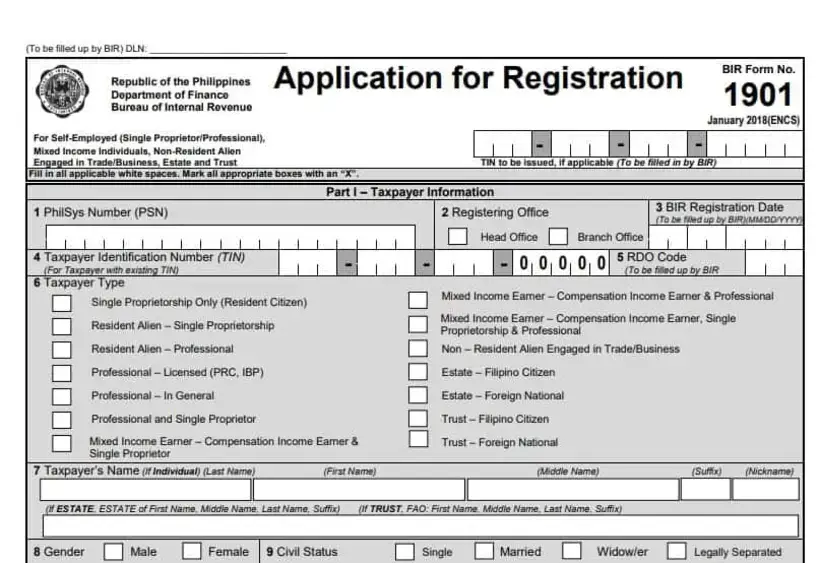
BIR Form 1901 is a versatile document with a range of applications in the realm of taxation. Primarily designed for self-employed and mixed-income individuals, it serves as a fundamental tool for tax registration. This form is not limited to new entrepreneurs; it’s also essential for those expanding their businesses by opening new branches, ensuring seamless tax compliance throughout their ventures.
Moreover, BIR Form 1901 extends its utility to the realm of estates and trusts. Individuals involved in estate management and those preparing for estate tax return filing can use this same form to facilitate their registration process, streamlining the path to fulfilling their tax obligations in a structured and efficient manner.
Who Is Required to Submit BIR Form 1901?
BIR Form 1901 casts a wide net, encompassing a diverse range of individuals and entities within the Philippines’ tax landscape. It is mandated for submission by a broad spectrum of taxpayers, including:
- Sole proprietors, regardless of their nationality and residency status, who may operate businesses as either residents or non-residents.
- Professionals engaged in the practice of their respective fields.
- Freelancers who provide various services independently.
- Professionals or employees who wear dual hats, functioning as both sole proprietors and holding employment.
- Employees who concurrently operate as professionals in addition to their salaried employment.
- Taxpayers skillfully managing multiple roles as employees, sole proprietors, and professionals simultaneously.
- Individuals with consistent earnings extending beyond employer payments, such as home-based service providers to foreign entities and cryptocurrency dealers.
- Estates, representing both Filipinos and foreigners.
- Trusts, with inclusion for both Filipino and foreign entities.
BIR Form 1901 serves as a pivotal instrument for tax registration and compliance, catering to a diverse array of taxpayers operating within the Philippine tax system.
What Is the Cost of Registration?
For those engaging in the tax registration process with BIR Form 1901, it’s essential to be aware of the associated fees. The annual registration fee (ARF) for this form amounts to Php 500, making it a recurring payment due by January 31st each year.
In addition to the ARF, there are additional charges to consider. A Php 15 fee is levied for the documentary stamp tax (DST), which is essential for legal documentation, and another Php 15 for the certification fee. It’s worth noting that while registration itself is a one-time process, the ARF represents an annual obligation that taxpayers must fulfill in order to maintain their tax compliance.
Filing BIR Form 1901 for Self-Employed and Mixed-Income Individuals
Where to Complete Your Registration
When initiating the registration process, it’s crucial to connect with the appropriate Revenue District Office (RDO) that oversees your business operations. This means that if you have a single business location, you should register with the RDO governing that specific area, whether it’s your primary head office or a branch.
However, for businesses that operate across multiple locations, such as mobile store operators, it’s advisable to register with the RDO corresponding to your official place of residence. This streamlined approach ensures that you establish a clear line of communication and compliance with the RDO that holds jurisdiction over your specific business activities, ultimately facilitating a smoother registration process.
Essential Requirements for Completing BIR Form 1901
When undertaking the process of filing BIR Form 1901, there are several key requirements that you should be prepared to provide. These essential documents and information are necessary for a smooth and successful registration:
- BIR Form 1901: You will need two completed copies of BIR Form 1901. This serves as the core document for your tax registration and is a fundamental component of the process.
- Proof of Identity: To establish your identity, you should have your birth certificate, community tax certificate, or a valid ID that displays your full name, birthdate, and current address.
- Additional Documentation for Sole Proprietors: If you’re a sole proprietor, you should include a photocopy of your Mayor’s Permit, or the application form if it’s still in the process, or the DTI Certificate of Business Name Registration.
- Additional Documentation for Professionals: Professionals need to present their Professional Tax Receipt or Occupational Tax Receipt from the Local Government Unit (LGU) as part of their registration requirements.
- Proof of Payment for Existing TIN Holders: If you already hold a personal Taxpayer Identification Number (TIN) and are registering a new business, you’ll need to provide proof of payment for the Annual Registration Fee (ARF).
- Payment Forms for Unpaid ARF: In cases where the ARF is unpaid, you should complete two copies of BIR Form 0605, the Payment Form, as part of your registration process.
- BIR Form 1906: An essential component of the registration process, you must complete BIR Form 1906, which is the Application for Authority to Print Receipts and Invoices.
- Sample Receipts or Invoices: You should include clear samples of your principal receipts or invoices, which are pivotal for tax documentation and record-keeping.
- Barangay Clearance: A Barangay clearance is another requirement, ensuring compliance with local authorities.
- President’s Referral (for Residents in Subdivisions): In the case of residents in subdivisions, a President’s referral may be needed as an additional requirement.
By gathering and submitting these necessary documents and fulfilling the associated requirements, you can navigate the BIR Form 1901 registration process with confidence, ensuring your tax affairs are in order and compliant with the Philippine tax regulations.
Supplementary Requirements (If Required)
In certain specific cases, additional requirements may be necessary to complete the BIR Form 1901 registration process, depending on the nature of your business and its operations. These supplementary documents include:
- Authorized Representative Documents: If you are utilizing an authorized representative for your registration, you’ll need a Special Power of Attorney (SPA) granting them the authority to act on your behalf, along with a copy of their valid identification.
- Franchise Business Documents: For businesses operating under a franchise model, it’s essential to provide the relevant franchise documents. This may include certificates such as the Certificate of Public Convenience for transport network services, as is the case with businesses like Grab.
- Barangay Micro Business Enterprises (BMBE): For entities registered under the Barangay Micro Business Enterprises (BMBE) category, the Certificate of Authority for this status is a crucial document to submit.
- PEZA/BCDA/SBMA-Accredited Businesses: If your business has earned accreditation from entities like the Philippine Economic Zone Authority (PEZA), Bases Conversion and Development Authority (BCDA), or Subic Bay Metropolitan Authority (SBMA), you should provide proof of your Registration/Permit to Operate from these organizations.
By adhering to these additional requirements when applicable, you can ensure comprehensive and accurate registration with BIR Form 1901, aligning your business with the relevant regulatory requirements in the Philippines.
Process for Submitting BIR Form 1901 by Self-Employed and Mixed-Income Individuals
Submission and Verification:
To initiate the process of filing BIR Form 1901, follow these steps:
- Submission of Requirements: Begin by submitting all the necessary documents and forms to the New Business Registrant Counter of the Revenue District Office (RDO) responsible for your business location. The registration officer will be your point of contact during this stage.
- Completeness Assessment: The registration officer will meticulously assess the completeness of your submission. They may ask you questions to clarify information and verify your taxpayer type, ensuring that the form is properly completed.
- TIN Verification: If you don’t already have a Taxpayer Identification Number (TIN), the registration officer will encode your data and generate a new TIN for you. For those with an existing TIN, your taxpayer records will be updated accordingly.
Fee Payment:
After the initial submission and verification, proceed with the following fee payment steps:
- Registration Fee Payment: Make payment for the registration fee at the authorized agent bank designated by the RDO. Upon payment, you will receive an official receipt and a machine-validated BIR Form 0605.
- DST and Certification Fee: At the RDO, settle the Documentary Stamp Tax (DST) and certification fee. Existing TIN holders may also consider prepaying the Annual Registration Fee (ARF) via Form 0605 before completing the registration.
Taxpayer’s Briefing:
- Mandatory Briefing: Attend the mandatory taxpayer’s briefing, which is a vital part of the registration process for new business registrants. This briefing provides an understanding of your taxpayer rights and responsibilities, ensuring you are well-informed about your obligations.
Document Retrieval:
- Document Collection: Once you have completed all the necessary steps and payments, collect the registration documents from the registration officer. These documents may include the BIR Form 2303 (Certificate of Registration), the “Ask for a Receipt” Notice (ARN), Authority to Print (ATP) if applicable, and a BIR-printed receipt or invoice, if needed for your business. Additionally, you will receive an eReceipt as proof of payment, further solidifying your registration with BIR Form 1901.
Post-Registration Steps: What Comes After BIR Registration
Compliance and Ongoing Obligations:
After successfully completing your BIR registration, there are several crucial steps to follow in order to maintain tax compliance and ensure the smooth operation of your business:
- Visible Display of BIR Certificate and “Ask for a Receipt” Notice: Upon receiving your BIR Certificate of Registration, it’s imperative to prominently display it alongside the “Ask for a Receipt” Notice in a visible area at your office or business location. This not only informs customers of your compliance but also fosters transparency in financial transactions.
- Utilize BIR Form 2303 as a Tax Reference: BIR Form 2303, the Certificate of Registration, should serve as your go-to reference for all matters related to tax returns, payments, and deadlines. Familiarizing yourself with this document ensures that you stay updated on your obligations and can meet them in a timely and organized manner.
- Issuance of Invoices or Receipts for Payments Over Php 1001: As a registered business entity, it’s essential to adhere to the requirement of issuing invoices or receipts for payments exceeding Php 1,001. This practice not only maintains compliance but also enhances the credibility of your financial transactions.
Financial Record-Keeping and Audit (if Applicable):
- Maintaining Books of Accounts and Submitting Yearly Account Information: For businesses, particularly those with substantial operations, maintaining accurate books of accounts is essential. Moreover, submitting a yearly account information return or financial statements is a standard practice that ensures transparency and compliance with tax regulations.
- Auditing for Gross Annual Sales Exceeding Php 3,000,000: In cases where your business reports gross annual sales exceeding Php 3,000,000, auditing your books becomes mandatory. This process is conducted by independent Certified Public Accountants, aligning your income tax returns and requiring the submission of an Account Information Form (AIF).
- Book of Accounts Registration: To formalize your financial record-keeping, it’s necessary to apply for book of accounts registration at the Revenue District Office (RDO) where your business is registered. This step includes having your journals, ledgers, or equivalent books officially stamped, thereby ensuring the legality and credibility of your financial records.
By adhering to these post-registration steps, businesses can maintain their tax compliance, instill trust among customers, and navigate the financial landscape with transparency and accuracy, ultimately contributing to their long-term success.
Filing BIR Form 1901 for Estates and Trusts: A Step-By-Step Guide
For estates and trusts, the process of filing BIR Form 1901 involves specific steps and requirements tailored to their unique nature. Here’s a breakdown of the process:
Where to Register:
- Estates: To initiate the registration for estates, it’s essential to connect with the Revenue District Office (RDO) with jurisdiction over the deceased person’s residence at the time of death. For foreign deceased persons, registration is to be carried out in the RDO where the administrator or executor is registered.
- Trusts: Trusts should be registered with the RDO having jurisdiction over the trustee’s registered address. It’s crucial to ensure the trustee’s location aligns with the designated RDO.
Basic Requirements:
For both estates and trusts, the initial requirements include:
- For Estates Under Judicial Settlement: A photocopy of the deceased person’s death certificate. This document establishes the basis for the estate registration.
- For Trusts: A photocopy of the Trust Agreement, serving as the foundational document for trust registration.
Additional Requirements (if applicable):
The specific nature of the estate or trust may necessitate additional documents. These might include:
- Marriage Certificate (for Estates Only): Required in the case of estates, the marriage certificate helps verify relationships and legal entitlements.
- DTI Certificate of Business Name Registration: Necessary if the estate or trust operates under a business name.
- Certificate of Authority (for BMBE-Registered Entities): For entities registered under the Barangay Micro Business Enterprises (BMBE) category, this certificate may be required.
- Proof of Registration/Permit to Operate (for PEZA/BCDA/SBMA-Accredited Businesses): Accredited businesses under these entities must provide documentation indicating their registration and permit to operate.
- Franchise Documents: If your estate or trust operates under a franchise model, these documents are essential.
Filing Procedure:
The filing procedure for estates and trusts is streamlined:
- Submit Requirements: Gather all the necessary documents and submit them to the designated RDO, ensuring that you have all required documents as per your specific case.
- Payment of Annual Registration Fee (ARF): The final step involves paying the Annual Registration Fee (ARF) of Php 500 at the RDO’s authorized agent bank. This payment solidifies your registration, ensuring that your estate or trust complies with the regulatory requirements.
By following these steps and ensuring the submission of all required documents, estates and trusts can achieve proper registration with BIR Form 1901, allowing them to operate within the legal framework and meet their tax obligations.