

In simple terms, the Department of Foreign Affairs (DFA) in the Philippines not only issues passports but also authenticates documents.
This authentication was previously known as the “red ribbon” authentication, where red satin ribbons were attached to public documents that were going to be used in foreign countries.
However, from June 17, 2019, the DFA stopped issuing these “red ribbons”. Instead, they started providing Apostille certificates. This change happened because the Philippines joined the Apostille Convention.
Now, you might wonder, what is an Apostille certificate and how is it different from the “red ribbon” certificates we knew?
In this guide, we’re going to explore everything about this new authentication process. It’s important to note that this change has made the process of getting documents ready for use abroad much simpler.
What is an Apostille?
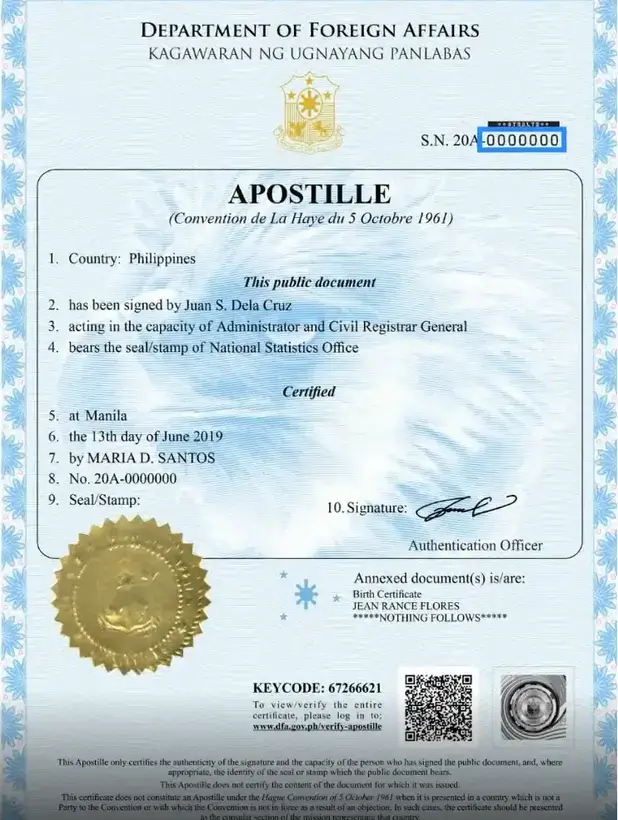
An Apostille is a certificate that authenticates the signature of a public official on a document intended for use in another country. It confirms that the issuer of the document is recognized by the government of its origin country, is authorized to issue such documents, and that the document is genuine.
Why is Document Authentication Necessary?
Imagine you have a PSA birth certificate from the Philippines. Birth certificates from different countries vary in appearance and processing methods. So, how can a foreign country accept a document, like a birth certificate, from a completely different country with different laws and cultures?
This is where authentication comes into play. Since the 1963 Vienna Convention on Consular Relations, embassies or consulates worldwide have followed a uniform authentication procedure to ensure that a document processed in one country remains valid in another.
The purpose of having your documents authenticated by the DFA is to assure foreign embassies or consulates that the documents have been thoroughly reviewed, examined, and subjected to an agreed-upon authentication procedure.
In essence, DFA authentication guarantees foreign embassies that the document you’re submitting is genuine and was issued by a recognized Philippine government agency.
What’s the Difference Between DFA “Red Ribbon” and Apostille Certificate?
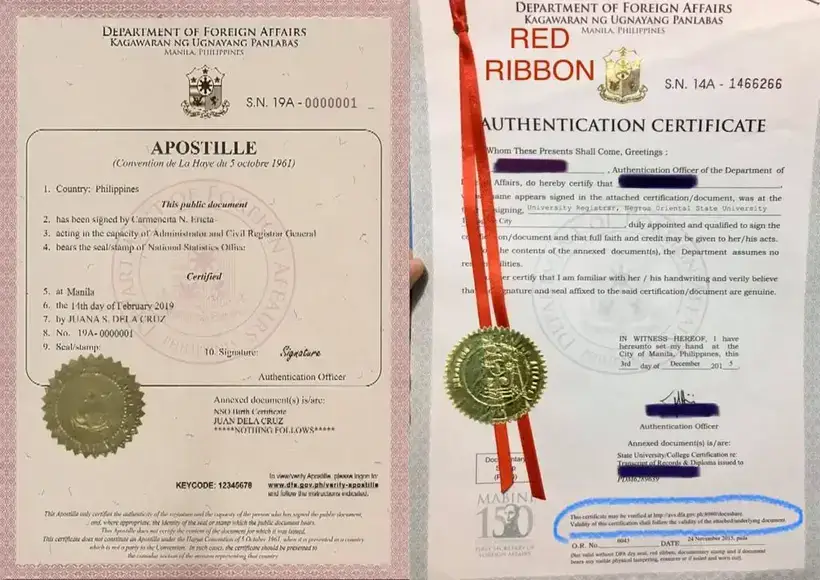
Filipinos were familiar with “red ribbons” for document authentication. However, starting June 17, 2019, DFA stopped issuing “red ribbon” certificates and replaced them with Apostille certificates to streamline the authentication process.
Here’s a comparison of the two:
- Red Ribbon Document: Featured a gold seal over two red ribbons fastened to the same side. It took longer to process as the document had to be authenticated by DFA before it could be submitted to the foreign country’s consulate in the Philippines for certification/legalization.
- Apostille Certificate: The new version (blue) shows a gold seal, a QR code, and the signature of the Authenticating Officer. It’s simpler and faster to process as the document only requires DFA authentication.
On September 12, 2018, the Philippines formally acceded to the Apostille Convention in The Hague, Netherlands. This international treaty allows signatory countries to accept documents issued by another signatory country without additional consular authentication. This is what makes the Apostille certificate different from the discontinued “red ribbon” certificates.
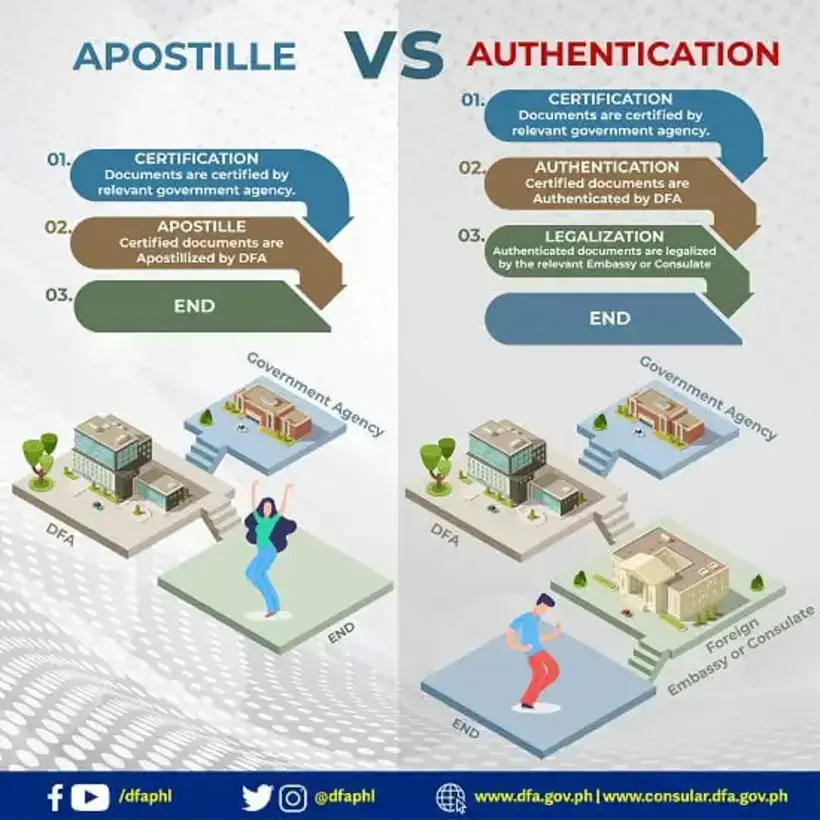
With the Apostille certificate, Filipinos can use their authenticated documents in any Apostille-contracting country without undergoing another consular authentication or legalization procedure. In other words, you only need to go to the DFA to authenticate your documents. There’s no longer a need to go to the Consular Office of your destination country, making the whole process easier, faster, and cheaper.
Which Countries Accept the Apostille Certificate for Authenticated Documents?
An Apostille certificate issued by DFA in the Philippines is only accepted by other countries that are also signatories to the Apostille Convention.
For a complete list of Apostille-contracting countries, please refer to this link or view the image below.
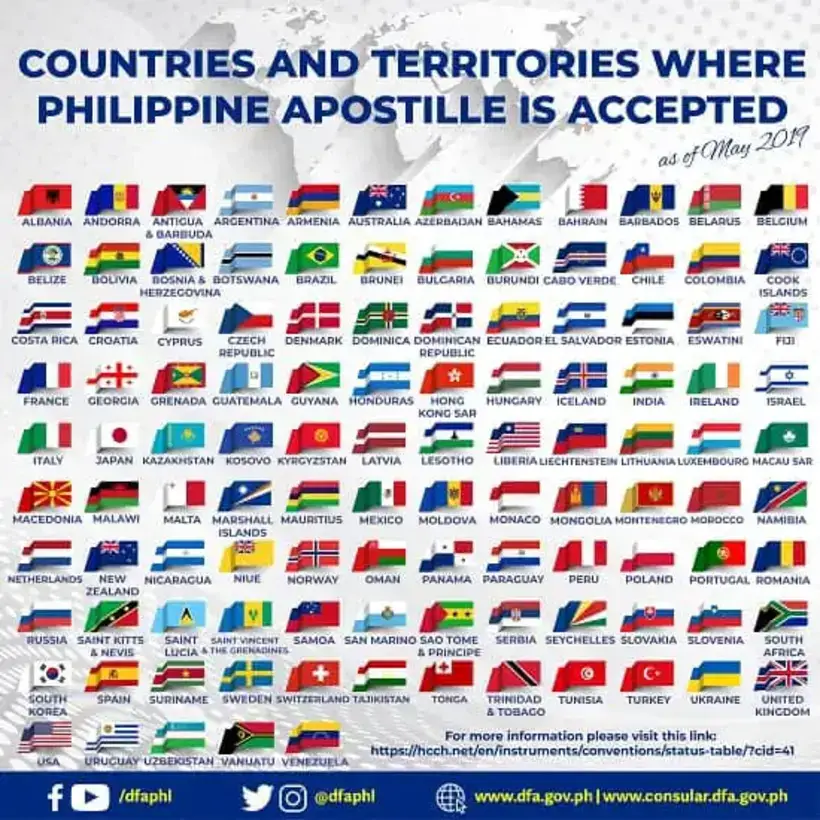
However, Apostille certificates are not accepted in Austria, Germany, Greece, and Finland.
What Documents Can Be Apostilled?
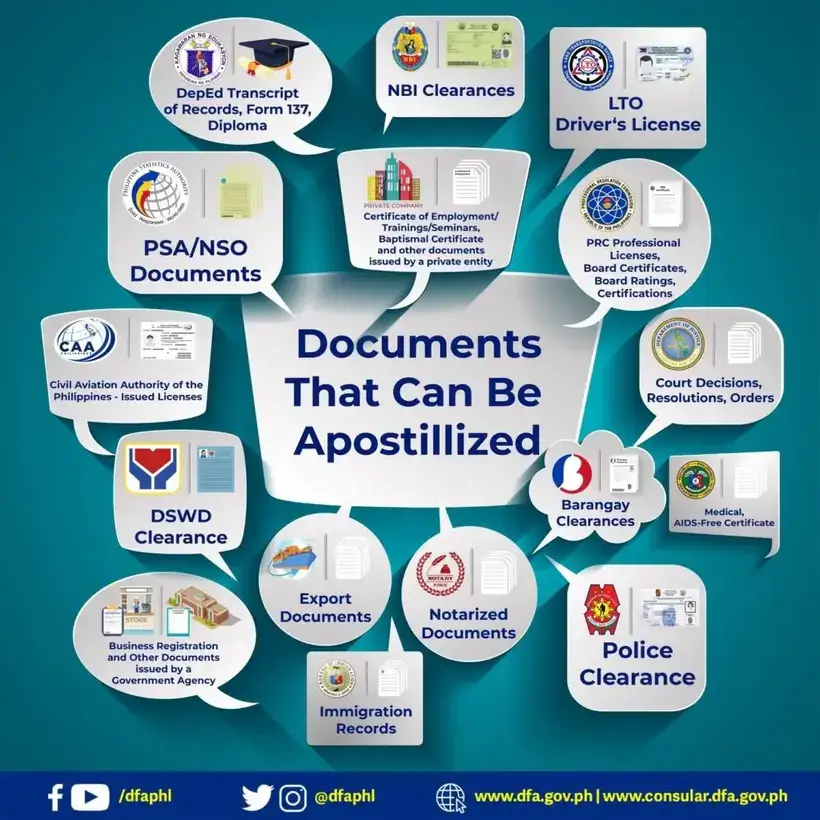
Apostille certificates can be issued for a wide range of documents. Below is a list of documents that can be authenticated and receive an Apostille Certificate:
Documents Issued by Public Entities
- Local Government Units: Documents released by local government units are eligible for Apostille.
- Government Agencies: Any document issued by a government agency can be Apostilled.
- Judicial Courts: Legal documents from judicial courts can receive an Apostille.
- Public Schools and State Universities: Educational documents from public institutions are subject to DFA authentication and can be Apostilled.
Documents Issued by Private Entities
- Private Documents: Documents from private entities must be notarized and issued with a Certificate of Authority for Notarial Act (CANA) by the Regional Trial Court before they can be Apostilled.
Specific Documents and Their Requirements
- Educational Documents (State Colleges and Universities):
- Bring Certified True Copies from the school.
- Must have the Certification, Authentication, and Verification (CAV) signed by the school/university registrar or authorized signatory.
- Educational Documents (Private Schools and Local Universities and Colleges):
- Bring Certified True Copies from the school.
- Must have the CAV from the Commission on Higher Education (CHED).
- Technical or Vocational Courses Documents:
- Bring Certified True Copies from the school.
- Must have the CAV from the Technical Education and Skills Development Authority (TESDA).
- High School and Elementary Level Documents:
- Bring Certified True Copies from the school.
- Must have the CAV from the Department of Education (DepEd) Regional Office.
- Medical and Health Certificates:
- For employment, a Department of Health (DOH) stamp is required.
- For other purposes, obtain a Certification from DOH with the attached Medical Certificate.
- Licenses and Certifications:
- Civil Aviation Authority of the Philippines (CAAP) Licenses: Certified/authenticated by CAAP.
- Driver’s License: Certification from the Land Transportation Office (LTO) main branch.
- Professional Licenses and Other PRC Documents: Must be original.
- Employment and Personal Documents: Certificate of Employment, Invitation Letters, and similar documents need a notarized affidavit and a CANA from the Regional Trial Court.
- Legal and Contractual Documents: Special Power of Attorney, contracts, affidavits, and similar documents require a CANA from the Regional Trial Court.
- Court Documents: Bring true certified copies of the documents.
- Immigration Records: Must be certified/authenticated by the Bureau of Immigration (BI).
- DSWD Clearance: Original documents issued by the Department of Social Welfare and Development (DSWD) for minor travel clearance.
- NBI and Police Clearances: Original documents with a dry seal, issued by the National Bureau of Investigation (NBI) or the Philippine National Police (PNP).
- Barangay and Mayor’s Clearances: Certification with jurisdiction over the Barangay of the applicant’s residence.
- Export Documents: Must be certified/authenticated by relevant agencies like DOH, PCCI, BFAD, or DA.
- Business and Government Agency Documents: Certified True Copies from the issuing office such as SEC, DTI, BIR, SSS, etc.
- Vital Records (Birth, Marriage, Death Certificates, CENOMAR):
- Original documents issued by the Philippine Statistics Authority (PSA) or the National Statistics Office (NSO).
- If entries are unclear, provide a Local Civil Registrar (LCR) copy certified by PSA.
Note: The above list is not exhaustive, and other documents may also be eligible for an Apostille. Always check the latest guidelines from the Department of Foreign Affairs (DFA) for the most current information on document authentication.
What Are the Requirements for Getting an Apostille Certificate in the Philippines?
Before proceeding to the Department of Foreign Affairs (DFA) office, ensure that you have the following necessary documents:
Valid Government-issued ID
Bring both an original and a photocopy of at least one valid government-issued ID. This can include:
- Digitized government-issued IDs bearing the applicant’s signature, except for the Pag-IBIG Loyalty Card.
- Senior Citizen, PWD, Solo Parent, Voter’s ID/Certification, Passport, Seaman’s Book, or Alumni ID.
- Digitized Student ID (valid for the duration of the applicant’s studies and up to 1 year upon graduation).
Requirements for Authorized Representatives
If you are an authorized representative applying on behalf of the document owner, you will need to provide the following:
- An Authorization Letter from the document owner.
- A photocopy of the document owner/applicant’s ID.
- Both the original and a photocopy of the representative’s ID.
- If the document owner/applicant is a minor, an original Special Power of Attorney (SPA) from the parents is required.
Document(s) to be Authenticated
Finally, bring the document(s) you wish to have authenticated. Please refer to the previous list of eligible documents for authentication and Apostille.
What is the Cost of Apostille in the Philippines?
The fee for document authentication and receiving an Apostille in the Philippines varies based on the processing speed you prefer.
- For expedited service, which ensures you receive the Apostille within one to two working days, the cost is ₱200 per document.
- For standard processing, which takes three to five working days, the fee is a more affordable ₱100 per document (Office of Consular Affairs [OCA], 2023).
How to Obtain an Apostille for a Document in the Philippines?
There are two main methods to Apostille a document in the Philippines:
Option 1: Walk-in Application
Some DFA branches offer walk-in services for document authentication. However, be aware that the number of applications they can process in a day is limited by the capacity of each Consular office. Arriving early increases the likelihood of your request being processed.
The following DFA Authenticating Units provide Apostille services:
- DFA – OCA (Oceana)
- CO Cagayan De Oro
- CO East (SM Megamall)
- CO Northeast (Ali Mall)
- CO South (Alabang)
- CO West (SM Manila)
- CO La Union
- CO Iloilo
- CO Cebu
The walk-in facility can only be used by document owners (i.e., the document to be Apostilled is in your name) or by authorized representatives applying on behalf of immediate family members whose names appear on the document to be Apostilled.
Option 2: Online Appointment
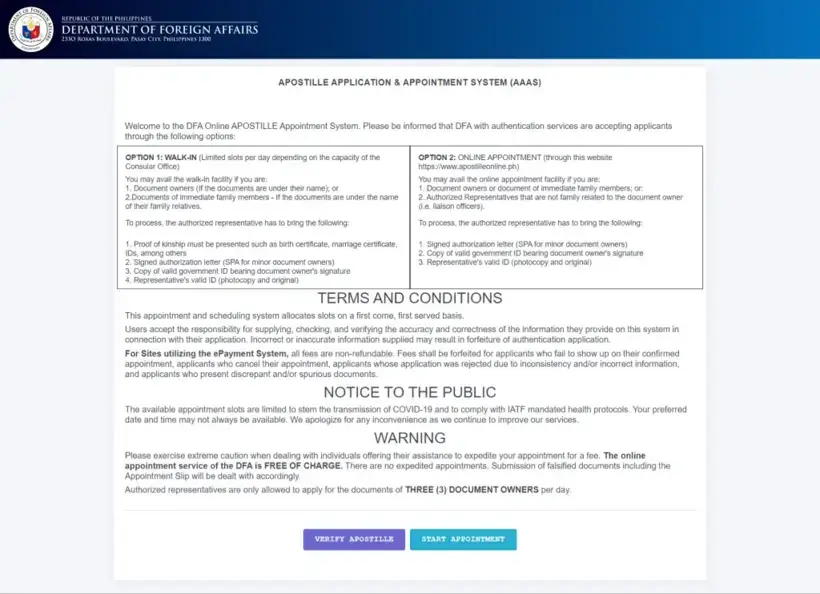
If you’re not in a rush, you can schedule an online appointment with the DFA. This allows you to have your documents authenticated at a time that suits you. However, appointment slots are allocated on a first-come, first-served basis, so it’s best to book as soon as you can. Here’s how to do it:
- Visit the Apostille Application & Appointment System (AAAS).
- Scroll to the bottom of the page and click “Start Appointment”.
- If you’re a first-time user, click “Create New Account” to register.
- Enter your name, contact information, and password. Accept the Terms and Conditions and click “Register”.
- Check your email for a confirmation message and click the link provided. This will take you back to the AAAS. Scroll down and click “Start Appointment” again.
- Login using your registered email address and password.
- Click “Start New Appointment”. A dialog box will appear with information about the required documents. Read it thoroughly and click “OK”.
- Complete the registration form. If you’re an authorized representative, enter the document owner’s name, date of birth, and destination country. If not, tick the box that says, “Are you a Document Owner?”. Select the type of document to be authenticated from the provided list. If you have more documents, click “Yes” to the question “Do you want to add another document?”. Click “Next” when you’re done.
- Choose the location where you want to apply for the Apostille and click “Next”.
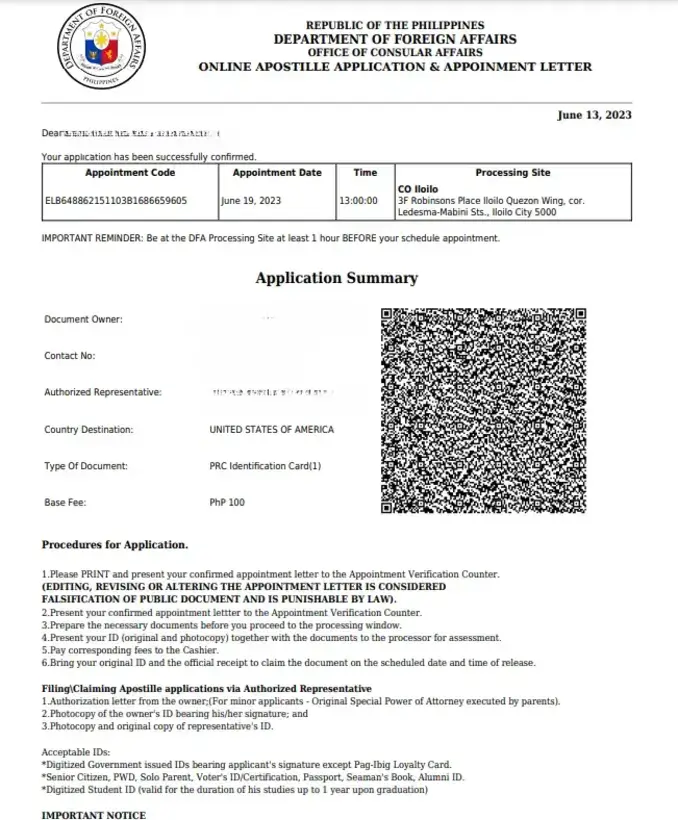
- Pick your preferred date and time, then click “Next”. A “Generate Appointment” dialog box will appear. Click “Ok”, and a PDF copy of your Online Apostille Application & Appointment Letter will be automatically downloaded. This letter includes your appointment details and the fee you’ll be charged.
- Print this letter and bring it to the Appointment Verification Counter on your appointment day.
- When your number is called, go to the processing window and present your valid ID and the documents.
- Pay the required fee at the Cashier.
- Finally, bring your original ID and the official receipt on the scheduled release date to collect your Apostille certificate.
Important Tips and Warnings for the Apostille Process
Here are some crucial tips and warnings to consider when obtaining an Apostille certificate in the Philippines:
- Apostille Validity: Apostille certificates do not have an expiration date.
- Limits for Authorized Representatives: Authorized representatives can only request the authentication/apostilization of documents for a maximum of three document owners per day.
- What an Apostille Certifies: An Apostille certificate only certifies the origin of the document or the authenticity of the person/authority whose signature/seal is on the public document. It does not certify the content of the document.
- Use of Apostille Certificates: Apostilles are only applicable to public documents that will be used abroad. Authentication and Apostille certificates will not be issued for documents intended for local use.
- Non-Apostille Countries: If the destination country is not a signatory to the Apostille Convention, you may need to have your documents legalized/certified by that country’s Consular Office/Embassy. For more information, please contact the foreign embassy or recipient of your documents to explore available options.
- Appointment Letter Modifications: Altering or revising information in your appointment letter is prohibited. Any necessary corrections will be made at the DFA site during your appointment.
Frequently Asked Questions
1. How Can I Verify the Authenticity of My Apostille Certificate?
You can verify the authenticity of your Apostille Certificate using the DFA Apostille Verification System online. To this end, you will need to enter the Apostille number, located in the upper-right part of the document, and the keycode, found to the left of the QR code.
Alternatively, you can scan the QR code on the certificate using a mobile device. If the certificate is authentic, an image of it will appear on your screen.
An authentic Apostille Certificate typically includes the following features:
- A dry seal of the DFA
- The signature of the Authentication Officer
- A QR code
- An eight-digit keycode
If you are unable to verify your Apostille on the DFA site, send an email with an attached copy of the certificate to oca.verification@dfa.gov.ph.
2. What if I Can’t Claim the Apostille Certificate on the Scheduled Release Date?
If you cannot claim your Apostille certificate on the scheduled release date, you can still retrieve it later. However, make sure to do so within three months of the release date, as the DFA disposes of all unclaimed documents after this period. This measure is in place to minimize fire hazards and free up storage space for new documents.
3. What Should I Do if I Need to Use a Document in a Country That Doesn’t Require an Apostille?
If the foreign country you’re dealing with does not require an Apostille for document authentication, get in touch with the country’s embassy or consulate. They will guide you through their specific requirements and processes for document authorization.