

In the realm of personal finance, the intricacies of tax return preparation often remain a mystery to many. However, delving into this process can yield valuable insights, not only into the accuracy of the information presented but also into potential financial gains.
This article sheds light on the benefits of understanding tax return preparation, emphasizing the Solvitio Indebiti principle, which underscores the concept of receiving payments not due. Specifically focusing on the Philippine context, the discussion explores why tax refunds occur, how they can be calculated, and the procedural steps for availing them.
The comprehensive information provided aims to empower readers with a deeper understanding of tax refunds, though it is important to note that the content serves as general information and not a substitute for professional tax advice. A disclaimer underscores the need for individualized guidance in navigating the intricacies of tax matters.
What is Income Tax Refund?
Income tax refunds result from an individual or entity having paid more taxes than required, typically stemming from sources such as salaries, freelancer income, or payments to tax-exempt entities. When taxpayers overpay their taxes, they become eligible for a refund, which is the excess amount returned by the government.
It is crucial to note that tax refunds must be actively claimed within a specific timeframe. In most cases, individuals must submit their refund claims within two years from the intended filing date. Failing to do so may result in forfeiture of the refund, underscoring the importance of timely and accurate tax filings.
This process ensures that taxpayers receive the rightful reimbursement of any overpaid taxes, promoting fairness and adherence to tax regulations.
Who Qualifies to Apply for Income Tax Refunds?
Eligibility for income tax refunds encompasses a diverse range of entities and individuals contributing to the national revenue system. This includes:
- Employees: Those engaged in formal employment, with taxes deducted at source from their salaries.
- Registered businesses: This category extends to self-employed individuals and freelancers who are required to report and pay taxes on their income.
- Juridical Persons: This involves entities such as corporations and partnerships, which are legal entities separate from their owners, having their own tax obligations.
In essence, the eligibility for income tax refunds is broad and covers a spectrum of taxpayers, comprising individuals like employees, self-employed individuals, and freelancers, as well as registered businesses and juridical persons like corporations and partnerships. This inclusivity ensures that various contributors to the economy have the opportunity to reclaim excess taxes paid, fostering a fair and equitable taxation system.
What Causes an Income Tax Refund to Occur?
Business Payment Challenges can significantly impact financial planning and operations. The requirement for customers to pay only once every quarter poses cash flow challenges for businesses, affecting their ability to meet immediate financial obligations. Additionally, the issue of customers not paying on time further exacerbates the situation, creating uncertainty and hindering effective budgeting.
On the other hand, Taxpayer Payment Challenges highlight the necessity for individuals to fulfill their tax obligations either quarterly or yearly. The risk of tax evasion through under-declaration or non-filing adds complexity to revenue collection efforts. To address these challenges, the Bureau of Internal Revenue (BIR) implements a Withholding Tax System, allowing taxpayers to pay in advance.
This system serves the dual purpose of estimating annual income to prevent tax evasion and acting as a prepayment mechanism for taxes. However, the system may lead to refunds when taxpayers overpay due to the estimation of annual income, resulting in a situation where they have paid more than owed to the government.
How Can I Calculate My Tax Refund in the Philippines?
The computation of annual income tax refunds involves determining the tax due, subtracting prepaid tax payments, and arriving at the final tax payable or refund. The formula is expressed as follows:
Tax Due − Prepaid Tax Payments = Tax Payable or Refund
This formula encapsulates the fundamental process of calculating whether an individual or entity owes additional taxes or is eligible for a refund based on the comparison of tax obligations and payments made.
1. Compensation Income for Employees
For employees with compensation income, the process involves specific steps and considerations:
a. Determine Applicable Row in the Revised Tax Table for Compensation

b. Identify the Income Range

c. Follow Prescribed Withholding Tax

d. Calculate Tax Due Based on Total Taxable Income
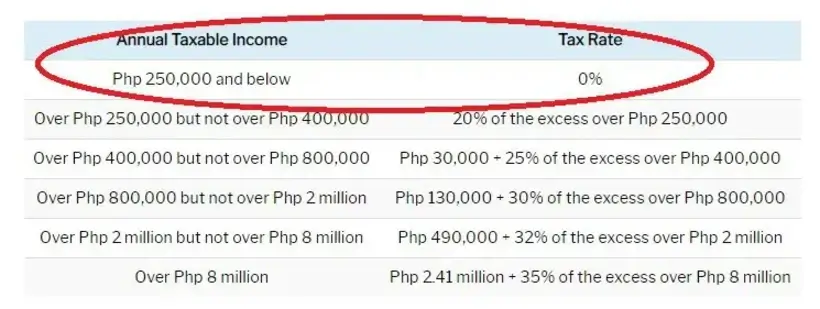
e. Compare Total Tax Withheld and Total Tax Due
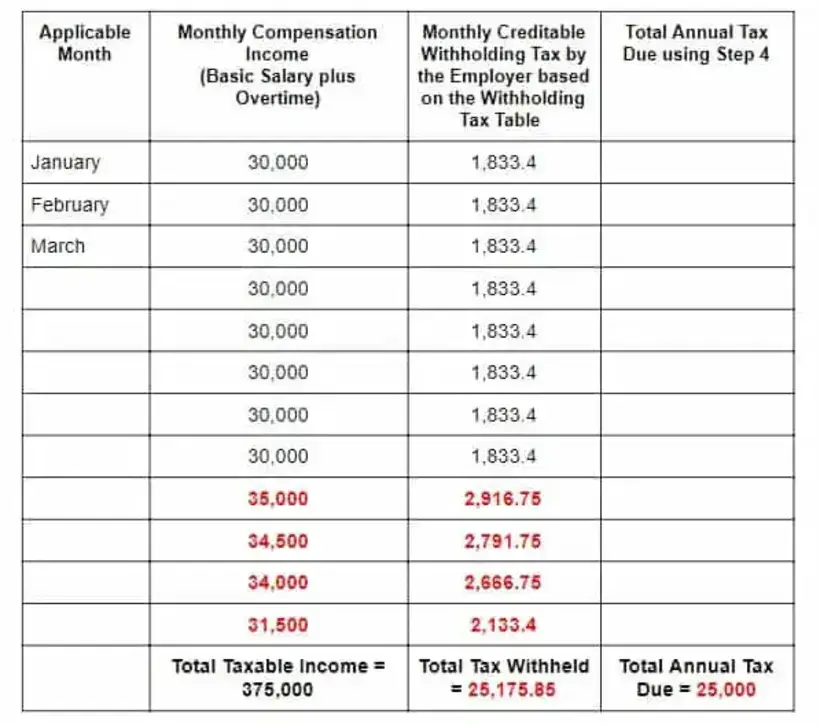
Computation of Tax Refund:
Total Annual Tax Due = Php 25,000
Less: Total Creditable Tax = Php 25,175.85
Tax Refund = Php 175.85
In this example, the employer over-withheld Php 175.85, refundable to the employee by January 25 of the following year.
2. Income Tax Refund for Registered Businesses, Professionals, and Freelancers
For registered businesses and professionals, the calculation involves determining tax payable, creditable withholding tax, and potential refunds. An example for licensed professionals is provided:
Gross Annual Receipts (Income from Professional Services): Php 250,000
Tax Payable Based on TRAIN Graduated Tax Table: Php 0
Creditable Withholding Tax Based on Expanded Withholding Tax System (5% of Gross Receipts): Php 12,500

Tax Refund Calculation:
Overpayment (for Tax Refund) = Php 12,500
In this scenario, the professional is entitled to a Php 12,500 refund from the Bureau of Internal Revenue (BIR).
How Can I Avail a Tax Refund in the Philippines?
1. For eligible employees entitled to substitute filing
Tax overpayment by employees can occur when employers file tax returns on behalf of their workforce, potentially resulting in excess tax payments. This situation often arises due to a lack of control over the payment process.
For employees who meet specific qualifications for substituted filing, such as having only one employer throughout the taxable year and not owning a business individually or with their spouse, there are benefits associated with this arrangement.
Qualified individuals are spared the need to apply for a tax refund, as excess tax payments are automatically returned by the employer through year-end adjustments in the usual payroll processing. This streamlined process requires no additional action from the employee, providing a hassle-free resolution to tax overpayment issues.
2. For individuals ineligible for substituted filing and entrepreneurs including licensed professionals, self-employed individuals, and freelancers
Taxpayers who are obligated to file their own taxes are mandated to provide proof of overpayment along with their tax submissions. In the case of businesses, the prescribed form for withholding tax certificates is BIR Form 2307, while employees utilize BIR Form 2316.
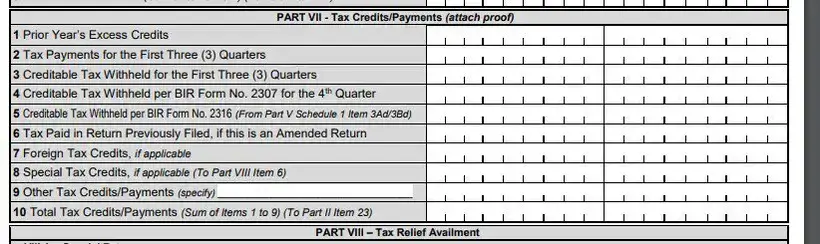
These certificates aggregate the amounts constituting the creditable withholding tax (CWT) for the entire fiscal year. In instances where a taxpayer’s tax liability falls below the total CWT, two alternatives are available.
- First, taxpayers can opt to claim a tax refund.
- Second, they may choose to carry over the excess to the subsequent taxable year, effectively offsetting it against future taxes.
It’s crucial to note that the decision between these options is irrevocable and cannot be altered once chosen. This process ensures that taxpayers have flexibility in managing their tax obligations and maximizing the benefits of overpayment.
When is the Appropriate Time Tax Refunds Are Issued?
1. Qualified for Substituted Filing
Individuals who receive tax refunds on or before January 25 of the subsequent year are deemed qualified for Substituted Filing. This streamlined process allows eligible taxpayers to experience expedited and simplified procedures for their tax filings. By meeting the January 25 deadline, individuals can enjoy the benefits of Substituted Filing, ensuring a faster and more efficient resolution of their tax affairs.
2. Not Qualified for Substituted Filing
Business owners, licensed professionals, self-employed individuals, and freelancers fall under the category not qualified for Substituted Filing. This exclusion applies when tax refunds are issued after the Commissioner of Internal Revenue declares no other tax liability to the Bureau of Internal Revenue (BIR).
The involvement of business-related considerations necessitates a more comprehensive review, and thus, these entities are subject to a different set of rules and procedures, excluding them from the Substituted Filing framework.
Frequently Asked Questions
1. What is the role of tax refunds in final pay computation?
When an employee resigns, understanding the components of the final pay becomes crucial. One such component is the tax refund, and it is imperative to know whether it is automatically included in the final pay computation.
2. How is the tax refund indicated in BIR Form 2316?
Employers play a vital role in providing employees with the necessary documentation. Discover how the details of the tax refund are indicated in BIR Form 2316, a key document provided by the employer.
3. What should a Business or Freelancer know about seeking a tax refund?
For those engaged in business or freelancing, the process of seeking a tax refund is different. Uncover the steps involved, from filing taxes using BIR Form 1701 to requesting a refund directly from the BIR in case of overpayment.
4. What factors determine the tax refund amount?
Understanding the intricacies of tax refund amounts is essential. Delve into the factors that influence the refund, including excess payments. For registered businesses, self-employed individuals, or freelancers, discover how other tax liabilities come into play.
5. What does the application process for tax refund involve?
The application for a tax refund is not a straightforward process. Learn about the mandatory BIR audit, a crucial step that can take anywhere from one to five years. Understand the intricacies involved in the application process.
6. How does resigning from a job impact the automatic tax refund?
Resigning from a job can have implications on the automatic tax refund. Explore the scenario where a resigned employee takes up a new job and no longer qualifies for substituted filing. Learn about the alternative – filing own taxes using BIR Form 1700.
7. What steps should a resigned employee take to claim a tax refund?
Discover the necessary steps a resigned employee should take to claim a tax refund. From filing own taxes using BIR Form 1700 to requesting a refund directly from the BIR using Form 1914 in case of overpayment, understand the process in detail.
8. Where can a claimed tax refund be received, and what does it entail?
Once the tax refund is claimed, the next step is to receive it. Find out where the check containing the requested amount is disbursed – the Revenue District Office (RDO) where the refund was applied. Additionally, learn about any deductions for tax liabilities.
9. Are there other types of tax refunds besides income tax refunds?
Tax refunds are not limited to income tax. Explore the various types of tax refunds, including VAT refund, excise tax refunds, and more. Understand that refund applications can be made for any overpayment of taxes, not just income tax.